
Policy Brief
Thematic Area: Trade, Investment, and Resilient Supply Chains; Sustainability and Energy Transition
Green Trade: Definition, Trends, and Recommendations
Introduction
Economic growth and climate change are interrelated, as economic progress pursued without regard for environmental impacts can lead to increased greenhouse gas emissions, resource depletion, and long-term ecological damage that threatens sustainable development. According to the International Monetary Fund (World Economic Outlook, April 2026), the global economy is expected to grow by 3.10% in 2026 and 3.20% in 20271.
Over the years, the global economy has been shaped by three defining characteristics: sustained economic expansion, deepening international interconnectedness reflected through the growth of global trade, and escalating climate change challenges, evidenced by rising greenhouse gas (GHG) emissions. As production capacity expands, countries invest more in transport and logistics, leading to increased trade and deeper integration with global markets. However, inefficient production methods contribute to higher greenhouse gas (GHG) emissions, and the fragmentation of Global Value Chains (GVCs) often shift production to regions with weaker environmental regulations, further exacerbating global emissions.
Climate Change and International Trade
Since the 1970s, world GDP has expanded from USD 3 trillion in 1970 to USD 110.98 trillion in 2024, reflecting that globalization and advancements in technology have played a significant role in facilitating trade and development2. However, the progress of expansion has been uneven with some countries developing more than others.
Trend in Greenhouse Gas (GHG) Emissions by Sector, 1970-2024
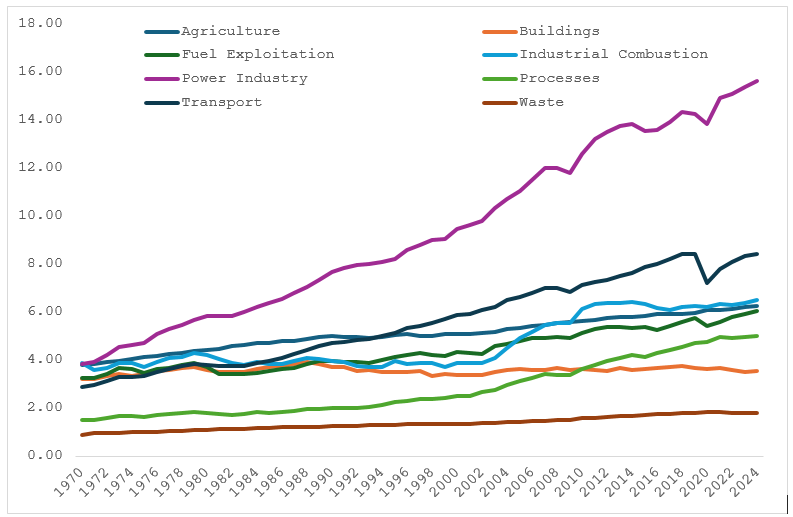
Source: EDGAR - Emissions Database for Global Atmospheric Research
With economic advancements, climate change vulnerabilities also expanded, which is evident from an increase in Greenhouse Gas (GHG) emissions to 53.20 Gt CO2eq in 2024 from 23.23 Gt CO2eq in 19703. This increase in GHG emissions is more profound for the power industry, followed by transport, industrial combustion, agriculture, fuel exploitation, processes, buildings, and waste.
Sectoral Contributions of Global Greenhouse Gas Emissions, 2024, (Gt CO2eq)
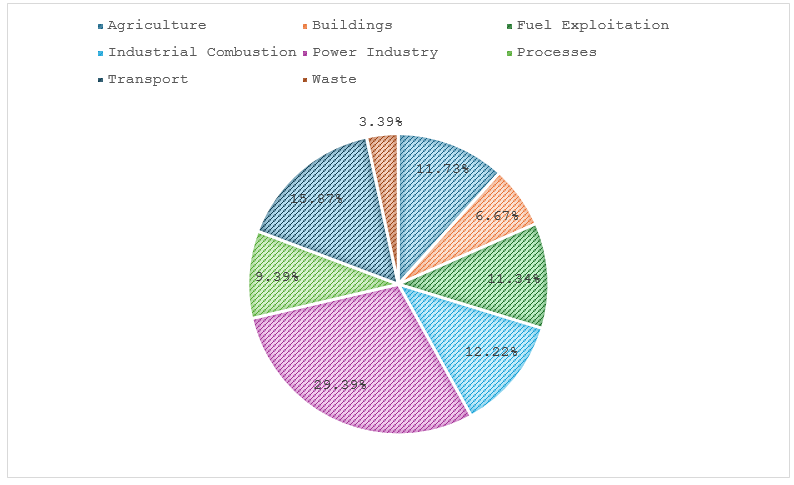
Source: EDGAR - Emissions Database for Global Atmospheric Research
International trade expanded noticeably from USD 0.32 trillion in 1970 to USD 25.77 trillion in 2025, reflecting profound transformations in the global economy. This growth was driven by advancements in production processes, including automation, supply-chain optimization, and technological innovation, which enhanced efficiency and reduced costs4. Meanwhile, the elimination of tariff and non-tariff barriers through the proliferation of Regional Trade Agreements (RTAs) also contributed substantially. Number of RTAs increased from 5 in 1970 to 382 in 2026 (cumulative number of RTAs in force), which has significantly expanded the scope of preferential trade arrangements, boosting trade and commercial linkages across countries5.
Within this context, there is a need to integrate advancements in international trade with climate change mitigation and adaptation strategies to boost green and sustainable trade. A study by Wang et al. (2023) discovered the impact of trade openness and trade diversification on carbon emissions using data from OECD and G20 countries between 1997 and 2019. The study concludes that the influence of trade on carbon emissions is not uniform, with greater trade openness tends to raise carbon emissions, while expanding the diversity of traded products helps decrease them6.
Hence, elimination of trade barriers should be integrated with trade diversification, with special emphasis on green trade to reduce GHG emissions and to boost sustainable methods of production.
What is Green Trade?
Diversification of trade can be in the form of greater exchange of environmental products and services, which contributes to lower carbon emissions, allowing countries to align their commercial interest with the Paris Agreement targets. There is no standard definition of green trade, as various organizations conceptualize it differently. The Organization for Economic Cooperation and Development (OECD) defines environment industry as "the environmental goods and services industry consist of activities which produce goods and services to measure, prevent, limit, minimize or correct environmental damage to water, air and soil, as well as problems related to waste, noise and eco-systems."7
The World Trade Organization (WTO), on the other hand, through the Environmental Goods Agreement (EGA) aims to eliminate tariffs by defining a comprehensive list of environmental goods. However, such efforts have resulted in partial success as trade barriers on environmental goods remain8.
Further, the United Nations Conference on Trade and Development (UNCTAD) categorized trade into Frontier Technologies and Environmentally Preferable Products (EPPs). Frontier Technologies are a combination of 17 advanced and environmentally sensitive technologies including Artificial Intelligence, Internet of Things, electric vehicles, solar and wind energy, and green hydrogen9. These technologies drive greater technological advancements in the market, while contributing to green technological revolution. Finally, EPPs are products that cause comparatively less environmental harm than conventional methods of production. This includes natural products and industrial goods designed for resource efficiency or reduced pollution10.
Therefore, different conceptual understanding creates a fragmented regulatory landscape that complicates the harmonization of green trade standards. Divergence in classifications between various multilateral organizations makes it difficult to establish a cohesive global framework for tariff reductions.
Trends in Green Trade
Data sourced from UN Trade and Development (UNCTAD) indicates a steady expansion in exports of biodiversity-based products, rising from USD 2.78 trillion in 2012 to USD 3.85 trillion in 2023, reflecting sustained growth in environmentally relevant trade flows. This corresponds to an approximate compound annual growth rate (CAGR) of 2.99%, which is driven by increasing global demand for sustainable products. Plastics trade, however, remains a dominant component, with exports growing from USD 0.89 trillion in 2012 to USD 1.13 trillion in 2023, also at a CAGR of about 2.17%, though its environmental implications remain a concern.
Exports of non-plastic substitutes, on the other hand, show more modest growth, increasing from USD 0.43 trillion to USD 0.48 trillion between 2012 and 2023, with a CAGR of around 1.15%, suggesting gradual but slower adoption of sustainable alternatives. Meanwhile, ocean goods trade rose from USD 0.68 trillion in 2012 to USD 0.90 trillion in 2023, reflecting a CAGR of approximately 2.52%.
While biotrade is expanding steadily, the relatively slower growth in substitutes compared to plastics highlights the need for streamlining trade barriers to accelerate transition towards environmentally sustainable goods.
Trends in Environment and Related Trade, USD trillion
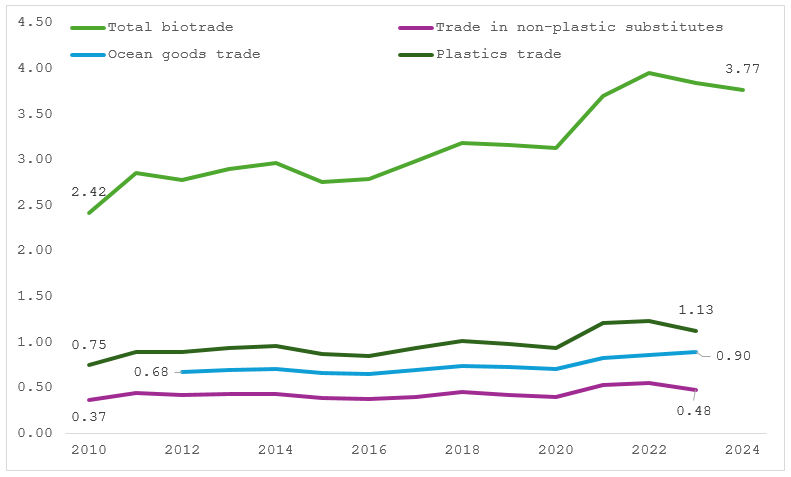
Source: UN Trade and Development, UNCTAD
Compound Annual Growth Rate (CAGR) of Trade in Environmental Products (2012-2023)
| Indicators | Compound Annual Growth Rate |
|---|---|
| Total biotrade | 2.99% |
| Trade in non-plastic substitutes | 1.15% |
| Ocean goods trade | 2.52% |
| Plastics trade | 2.17% |
Source: Author's Calculations Based on data from UN Trade and Development, UNCTAD
Recommendations to Boost Green Trade
Standardized Definition of Green Trade: Conflicting definitions often makes it difficult to conclude what constitutes a low-carbon product. Dual usage of some products also makes it cumbersome to classify them, for example, a pipe could be used for a green hydrogen plant or an oil refinery. A digital tracking of a product's carbon footprint throughout its lifecycle will standardize these metrics and ensure that green products align with global environmental benchmarks, preventing carbon leakage and promoting sustainable production.
Therefore, there is a need to adopt a standardized definition of a green product, based on uniform lifecycle carbon metrics to enhance transparency, minimize trade frictions, and facilitate seamless development of integrated green value chains.
Eliminate Tariffs on Environmental Goods: Fossil fuel subsidies are being gradually phased out11 through transition to cleaner technologies including electric vehicles, solar photovoltaic (PV), among others. Greater international exchange of such commodities is contingent on reducing trade barriers, lowering the cost of decarbonization to make renewable energy more affordable. Although tariffs on environmental goods are generally low, there is an increasing need to align and rationalize non-tariff measures (NTMs), particularly technical barriers to trade (TBTs), quantitative restrictions, and trade defence instruments, especially in the renewable and clean energy sectors12.
Green Foreign Direct Investments: The gap between developed and developing countries in green technologies could grow manifold, if developing countries fail to integrate the immense potential of advanced technologies such as AI and Internet of Things (IoT) in promoting sustainable methods of production13. Therefore, there is a need to boost two-way investments by offering tax incentives and streamlining customs and regulatory standards. For instance, establishing manufacturing plants in green hydrogen electrolyzers or batteries into developing markets, in combination with intellectual property waivers for essential climate-mitigation technologies to ensure a just transition.
Harmonized System (HS) Code Classification: To boost trade in environmental goods, HS Code classification can be evolved beyond its present structure to distinguish climate-critical technologies from carbon-intensive alternatives. Implementing such a mechanism would facilitate trade policies by enabling better standardization and certification processes, enhancing government support and procurement, rebalancing tariffs, and supporting effective implementation of carbon reduction strategies14.
Note:
1.https://www.imf.org/en/publications/weo/issues/2026/04/14/world-economic-outlook-april-2026
2.https://data.worldbank.org/indicator/NY.GDP.MKTP.CD
3.EDGAR - Emissions Database for Global Atmospheric Research
4.https://www.wto.org/english/res_e/statis_e/trade_evolution_e/evolution_trade_wto_e.htm
5.World Trade Organizations, Regional Trade Agreement, https://www.wto.org/english/tratop_e/region_e/region_e.htm as of 13 May 2026
6.Wang, Qiang & Fuyu, Zhang & Li, Rongrong. (2023). Free trade and carbon emissions revisited: The asymmetric impacts of trade diversification and trade openness. Sustainable Development. 32. 876-901. 10.1002/sd.2703.
8.https://tradebriefs.intracen.org/2025/7/spotlight
9.https://unctad.org/system/files/official-document/tir2023_en.pdf
10.https://unctad.org/system/files/official-document/unctadcom70.pdf
11.https://www.imf.org/en/topics/climate-change/energy-subsidies
14.https://www.wto.org/english/res_e/booksp_e/hydrogenirena112024_e.pdf