
Issue Brief
Thematic Area: Sustainability and Energy Transition
Economics of Lithium: Strengthening Supply Chain and Addressing Supply-Demand Gap
Introduction
Critical minerals are an essential component of low-carbon and green technologies. The term "critical minerals" is used worldwide to identify a select group of minerals that are essential for achieving countries' climate action goals under the Paris Agreement. They are the building blocks of a robust technological infrastructure that facilitates the transition to a green economy1.
Within critical minerals, Lithium remains an important mineral to boost sustainable production of electric vehicles and grid battery storage. The lithium mining industry creates positive externality not only in the construction and the mining sector, but also encourages startups and entrepreneurship, thereby fostering the transition to low-carbon emission and critical and emerging technologies. It enables greater use of renewable energy technologies in production processes across multiple industries, thereby lowering their environmental footprint. Additionally, the reuse of lithium through optimal e-waste management policies contributes to a comprehensive circular economic development.
The G20 Critical Minerals Framework
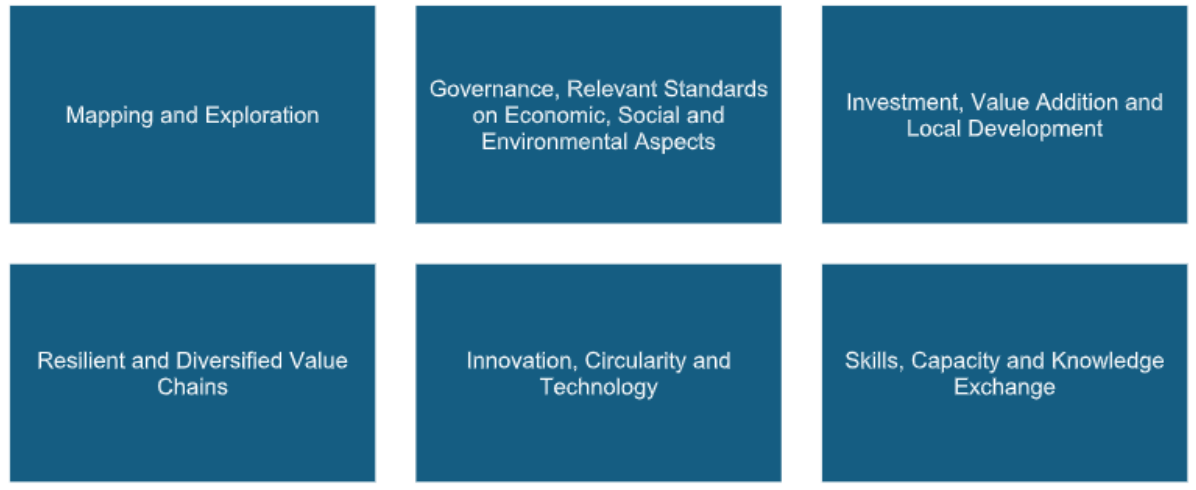
The Group of Twenty (G20) Critical Minerals Framework, introduced in November 2025, aims to facilitate equitable distribution of critical minerals across geographies, aligning with the rising industrial demand and greater adoption of sustainable technology2. However, the G20 does not have a dedicated vertical on lithium. It is embedded along with other minerals in the broader G20 Critical Minerals Framework. The Framework, endorsed at the G20 Johannesburg Summit 2026 under South Africa’s Presidency, is based on the following six pillars.
Six Pillars of the G20 Critical Mineral Framework
Source: G20 Information Centre3
Lithium: A Member of the Critical Mineral Group
Lithium, with atomic number 3, is considered the most important member of the critical mineral group due to its electrochemical property which efficiently stores and release energy, making it extremely valuable for battery technology4. With rising demand for electric vehicles, battery storage and increased focus on green energy transition, the importance of lithium is expected to increase even further in the coming future.
From a mining perspective, hard rock mining, solar evaporation brine extraction, traditional Direct Lithium Extraction (DLE) and lithium harvest solution are different extraction methods, each with different degree of project completion time and lithium yield. Hard rock mining takes approximately 10-17 years and produces 40-70% lithium yield, followed by solar evaporation brine extraction method which takes around 13-15 years with lower extraction yield of 20-50%. The other two methods are more efficient with lithium yield of at least 80%5.
With hard rock mining being the most used extraction method6, the long project completion time often contributes to supply-demand mismatch, thereby leading to volatile prices in the lithium market. Additionally, lithium extraction also poses significant environmental and social challenges including water depletion, land degradation, carbon emissions, waste generation and social and ethical concerns including worker safety and labor practices7. Therefore, there is a need to adopt faster and more efficient methods of lithium mining to bridge the demand-supply mismatch.
Stages of Lithium Supply Chain
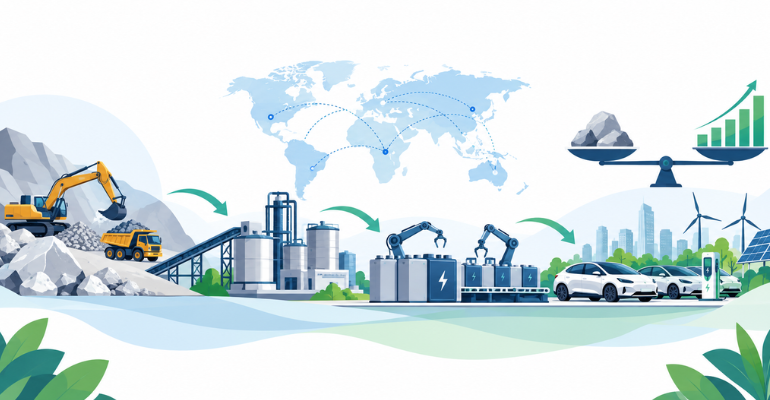
Across the supply chain, lithium extraction (mining) is the first stage of the three-part process to convert extracted lithium into processed industrial products which are further used as an input to manufacture actual batteries used in cars and mobile phones. The first stage involves extracting lithium-bearing resources from hard rock and brine deposits, which are subsequently processed and refined into usable lithium products, such as lithium carbonate and lithium hydroxide, in the refining stage8. Finally, processed lithium products are then integrated into the battery manufacturing process which further gets connected to electric vehicles and storage systems.
Stages of Lithium Supply Chain

Supply-Demand Analysis
Supply
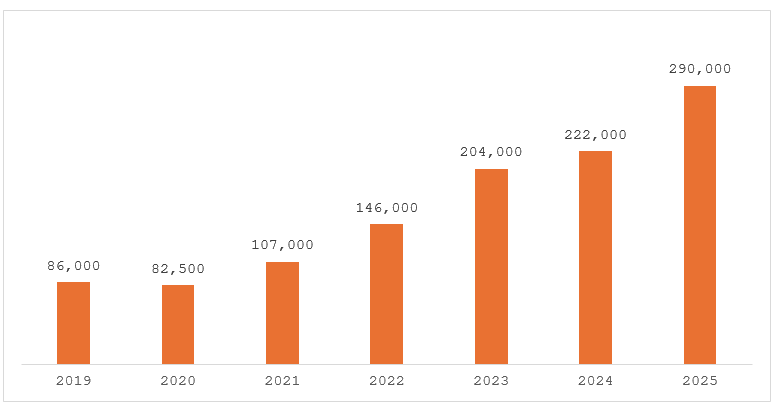
Global lithium production increased substantially from 86,000 tons in 2019 to 1,07,000 tons in 2021 reflecting the rising demand for EV and grid battery storage infrastructure. Production continued to grow and peaked at 290,000 tons in 2025, representing an increase of nearly 31% compared to 2024. This implies global commitment towards building a sustainable automobile infrastructure, integrating the use of low-carbon emission and green technology. It also reflects how upstream mining capacity has aligned with downstream energy transition targets.
Global Lithium Production, Metric Tons, 2019-2025
Source: U.S. Geological Survey9
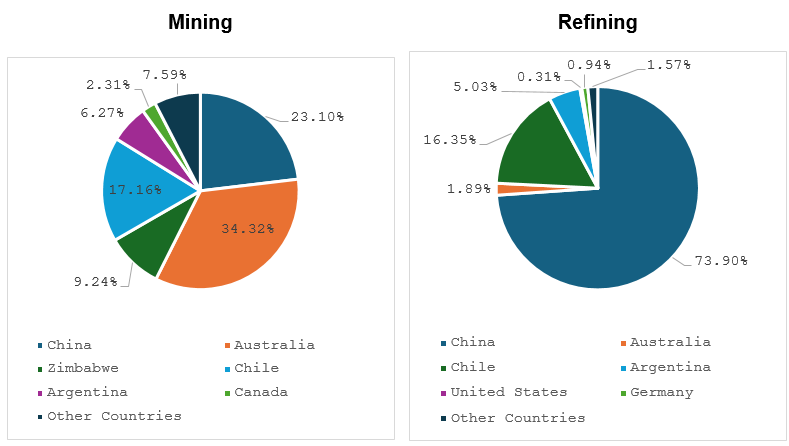
While China accounts for 23% of global mined lithium, its market share expands to nearly 74% in lithium refining. China’s near-monopoly in lithium refining grants the country significant leverage over global lithium supply and, consequently, prices, creating strategic vulnerabilities for import-dependent economies. This also implies that majority of lithium mined elsewhere, particularly in Australia, is shipped to China for refining before it enters the battery supply chain. Australia leads in lithium extraction; however, the country’s share falls dramatically to almost 2% of global refining output. South American countries (Chile and Argentina), on the other hand, maintain a balanced mining-refining ratio.
This exceptional geographical concentration in both mining and refining stages makes lithium vulnerable to geopolitical uncertainties, extreme weather events and trade restrictions. In the mining stage, Australia, China and Chile together accounts for 74% of total lithium extraction, while in the refining stage, China and Chile accounts for 90% of global lithium refining output.
Lithium supply from existing and announced projects in the base case, by country, 2025
Source: International Energy Agency (IEA)10
Demand
The demand for lithium in electric vehicles is expected to increase substantially by almost 4 times for EVs and by nearly 2 times for grid battery storage from 2025 to 2040. Under the International Energy Agency's (IEA) Stated Policies Scenario (STEPS), which reflects the direction of travel of the global energy system based on climate, energy, and related industrial policies that have been adopted or announced, while excluding aspirational targets11, the total demand for lithium in electric vehicles and grid battery storage is projected to increase from 275,000 metric tons in 2025 to 932,000 metric tons in 2040. While there is enough supply to cover demand in the medium term, lithium supply will struggle to meet the demand in the long run. By 2040, approximately 3,64,000 metric tons of lithium demand will remain unmet.
Supply-Demand of Lithium, 2025-2040, metric tons
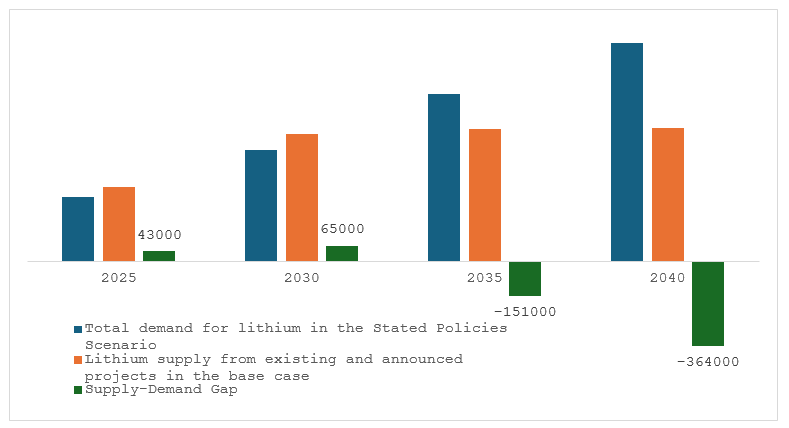
Source: Author’s calculations based on data from International Energy Agency (IEA)
Recommendations to Bridge the Supply-Demand Gap
-
Market Diversification
While the lithium mining market is relatively diversified, the refining market is highly concentrated, reflecting the need to develop substantial refining facilities in South American and African continents. Further investments in exploring critical mineral reserves in other markets, for example in Africa, can address the supply shortages. This can be paired with lucrative tax incentives, promoting innovation in research & development and expanding geological surveys for further information on critical mineral reserves across the world12. -
Optimal Pricing & Risk-Sharing Mechanism
According to the International Energy Agency (IEA), a threefold increase in the prices of battery minerals would have a relatively limited impact on end-product prices, raising the final cost of both electric vehicles and battery storage systems by around 5%. With higher establishment costs of new refining projects, particularly for countries outside the critical minerals supply chain, downstream users can absorb higher costs which allows diversification in lithium supply sources by charging a mineral security premium on final product prices. To further reduce costs, risk-sharing mechanisms for both supply and demand are recommended. For instance, tax credits and subsidies can reduce operating costs, while demand aggregation and offtake arrangements create a stable demand base for lithium13. -
Mineral-Specific Approach in the G20 Critical Mineral Framework
The G20 Critical Minerals Framework provides a broadened perspective on critical minerals as a group. However, each mineral is distinct with unique end-use applications and value chain dynamics. Therefore, a targeted, mineral-specific approach is recommended, one that addresses the entire value chain from extraction to downstream processing and establishes procedures to streamline regulatory barriers and de-risk investments. -
Accelerate Adoption of Direct Lithium Extraction (DLE) Method
Lithium extraction through conventional methods remains time-intensive, underscoring the need for faster and more efficient production technologies. In this regard, Direct Lithium Extraction (DLE) not only delivers higher recovery yields but also significantly reduces project implementation time and lower environmental impact. Therefore, DLE and lithium harvest solution can increase supply and eliminate demand-supply mismatch. -
Re-use of Lithium in Optimal e-waste Management Policies
As demand for lithium-ion batteries increases, it is recommended that countries adopt harmonised standards for end-of-life battery collection, safe dismantling and lithium recovery. Discarded electronic products contain critical minerals that are pivotal in production of new batteries14. Promoting recycled use of lithium through repair and reuse will enable greater supply security and support circular economic development. -
Addressing Geopolitical Uncertainties to secure Critical Mineral Supply Chain
Given the high geographical concentration of lithium mining and refining and prevailing geopolitical and trade uncertainties including export control measures that constrain supply15, it is recommended to diversify sourcing among friendly nations through investment in mining across stable regions. Further, building domestic processing and refining capacities reduces dependence on concentrated supply chains.
In conclusion, the anticipated demand-supply mismatch in the lithium market should be strategically addressed through measures aimed at market diversification, optimal pricing mechanisms and risk-sharing, development of mineral-specific roadmaps within multilateral groups such as the G20, adoption of efficient lithium extraction methods, promotion of e-waste management policies and exploration of new regions for mining reserves.
Note:
1. https://pubs.acs.org/aelccp/article/11/7/4741/5115147/Critical-Minerals-Critical-Moment-Rebuilding
2. https://www.g20.utoronto.ca/2025/251201-critical-minerals-framework.html
3. https://www.g20.utoronto.ca/2025/251201-critical-minerals-framework.html
4. https://lithiumharvest.com/knowledge/lithium/what-is-lithium/
6. https://www.saltworkstech.com/articles/hardrock-spodumene-lithium-processing/
8. https://www.eesi.org/files/FactSheet_CriticalMinerals_Lithium.pdf
9. https://www.usgs.gov/centers/national-minerals-information-center/lithium-statistics-and-information
10. https://www.iea.org/data-and-statistics/data-tools/critical-minerals-data-explorer
11. https://www.iea.org/reports/world-energy-outlook-2025/stated-policies-scenario
13. https://www.iea.org/reports/global-critical-minerals-outlook-2026/policy-pathways